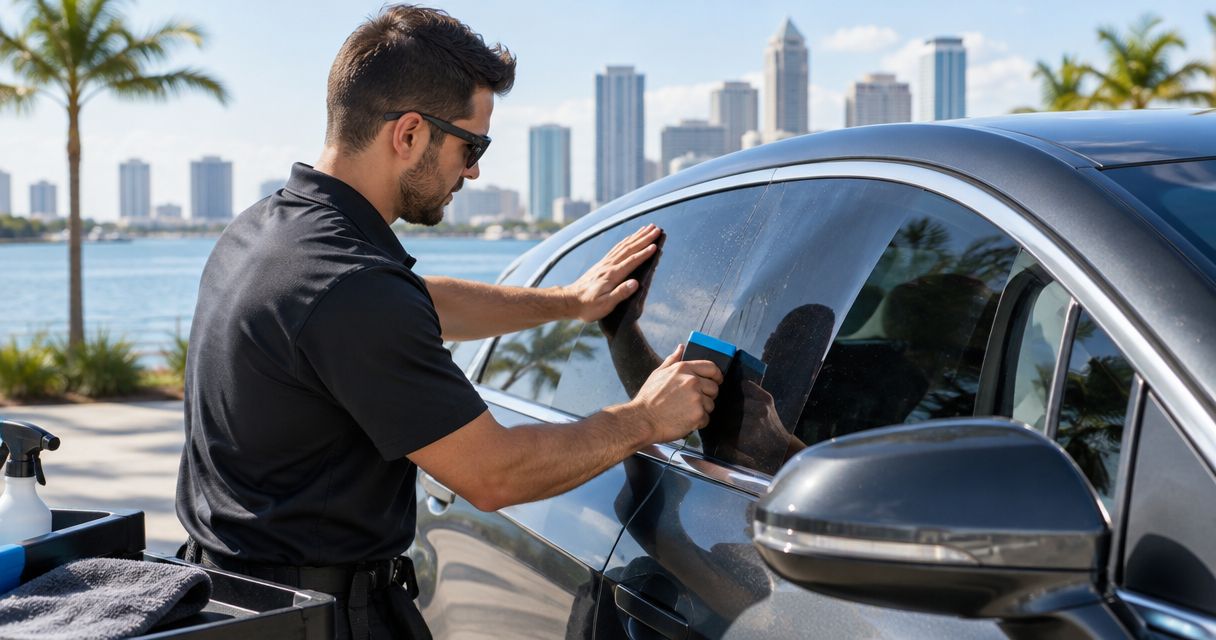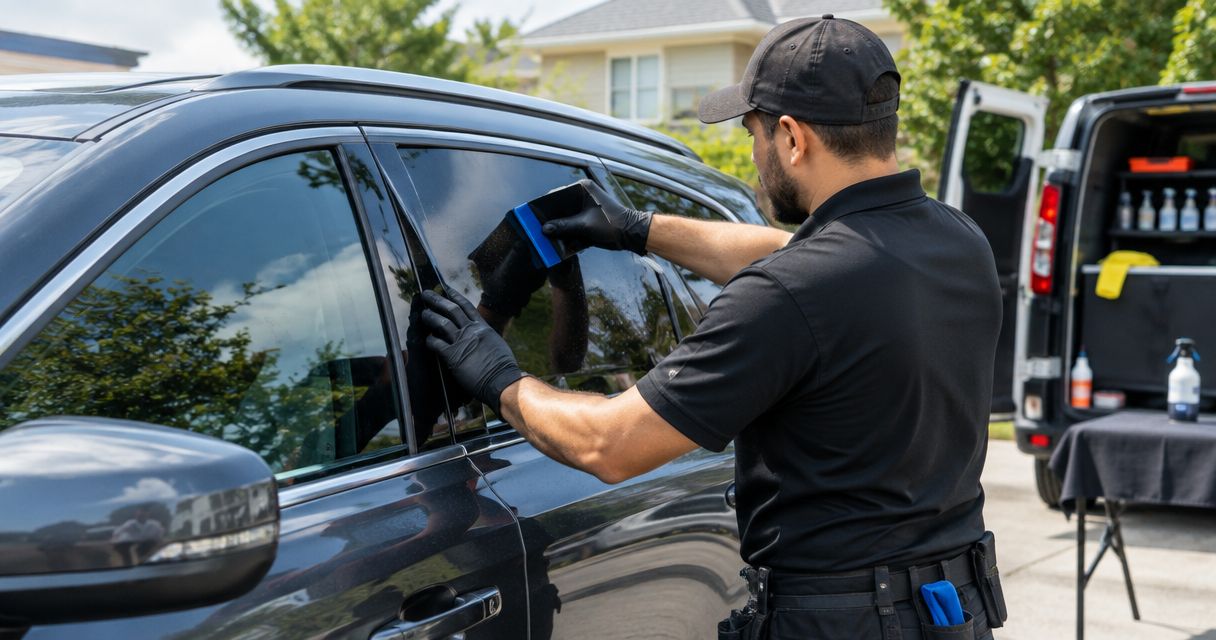
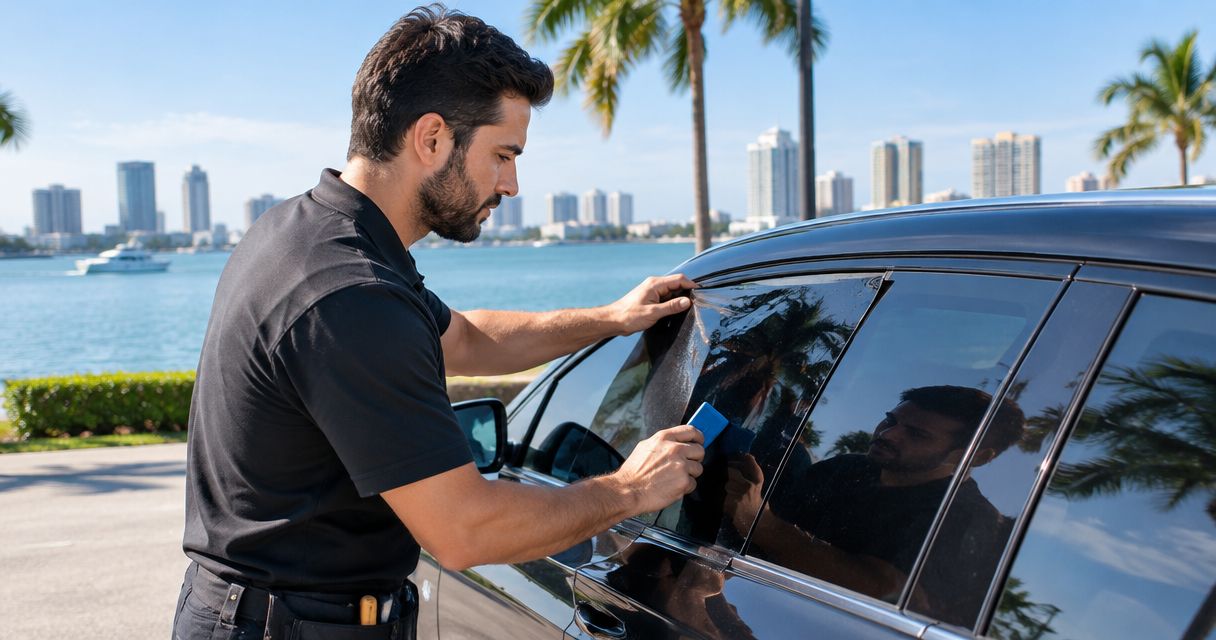
Best overall for heat-focused buyers: ceramic film. Best for a metal-free alternative: carbon film. Best for a reflective finish: metallized film. Best for appearance-first tinting: dyed film. For the best window tinting Sarasota drivers can choose in 2026, match the film to your priorities and check the installer—not just the darkness. Windowtintnear offers mobile window tinting for Sarasota drivers who want the installer to come to them.
- For best window tinting Sarasota searches, ceramic film is the first option to compare for heat rejection.
- Windowtintnear suits Sarasota drivers who want mobile window tinting rather than a separate shop visit.
- Choose film using documented performance, legal light transmission, installation conditions, and written aftercare instructions.
- Darkness alone does not establish heat rejection; compare the exact film proposed for your vehicle.
Why this matters in Sarasota
A darker window is not automatically a cooler window. Visible darkness, solar heat rejection, and ultraviolet protection describe different properties, so a shade sample cannot answer every buying question.
For Sarasota drivers comparing tint in 2026, the useful question is: Which film addresses my main problem without making visibility or legal compliance worse? Start there, then decide whether an on-site installation fits your parking situation.
This guide ranks film categories by use case, not local businesses by unverified reviews. A strong recommendation needs the exact film, a suitable installation location, and clear responsibility for the finished work.
What makes the best window tinting in Sarasota?
Use these criteria before comparing recommendations:
- Documented performance: Ask for specifications for the exact film and shade, not a general claim about ceramic technology.
- Legal light transmission: The finished glass-and-film combination matters, not just the percentage printed on a film sample.
- Usable visibility: Consider reversing, unlit streets, rain, and nighttime driving—not only midday appearance.
- Installation conditions: Mobile work needs a suitable location protected from contamination and weather.
- Written scope: Know which windows are included, whether existing film needs removal, and what aftercare applies.
- Clear accountability: Ask who handles installation concerns and what any written warranty actually covers.
Window tint options at a glance
The order below follows those priorities. These are film categories, not specific products; performance varies within each category.
| Rank and option | Best for | Standout characteristic | Key limitation |
|---|---|---|---|
| 1. Ceramic film | Heat-focused daily driving | Nonmetallic construction with heat-control options | The category name does not establish a particular film's performance |
| 2. Carbon film | A metal-free alternative | Carbon-based construction without a metallic layer | Heat rejection needs checking against the exact ceramic alternative |
| 3. Metallized film | Drivers who want a reflective finish | Metallic layers contribute to solar control | Reflectivity and possible signal interference need attention |
| 4. Dyed film | Appearance-first tinting | Changes visible shade without relying on a metallic layer | Darkness alone does not establish strong heat rejection |
1. Ceramic film: best window tint for heat-focused driving
Ceramic automotive films use nonmetallic materials to control solar energy. For Sarasota drivers whose main complaint is sun through the side windows, ceramic is the first category to investigate—not a reason to skip the specification sheet.
Best for: Drivers prioritizing heat control while choosing a shade that remains practical after dark.
Ceramic film pros
- Nonmetallic construction avoids the metallic layer associated with signal-interference concerns.
- Offers a route to heat control without choosing solely by visible darkness.
- Supports comparisons across different shades within a named film range.
Ceramic film cons
- The word ceramic alone does not establish heat rejection, clarity, or durability.
- Different performance measurements can make poorly explained comparisons misleading.
- A good film still needs careful preparation and installation.
Ask for total solar energy rejected, visible light transmission, and ultraviolet rejection for the proposed film. If an installer highlights infrared rejection, ask which measurement method supports that figure; infrared performance is not the same as total solar performance.
For a 2026 Sarasota tint quote, identify the film before choosing the shade. Verdict: Buy ceramic when the documented performance matches your heat-control priority.
2. Carbon film: best window tint for a metal-free alternative
Carbon films use carbon-based materials rather than a metallic layer. They belong on your shortlist when you want a nonmetallic film and are willing to compare its documented performance against the ceramic option offered.
Best for: Drivers who want a metal-free alternative and care more about the actual specification than the category label.
Carbon film pros
- Avoids a metallic layer in the film's construction.
- Gives you another category to compare against ceramic using the same measurements.
- Combines a change in appearance with solar-control properties that can be checked on a specification sheet.
Carbon film cons
- Carbon branding does not establish equivalence to a particular ceramic film.
- Appearance samples cannot tell you how much solar energy the film rejects.
- Broad category descriptions leave important differences between products unresolved.
Request a comparison at similar visible light transmission. Comparing a dark carbon film with a lighter ceramic film without acknowledging the shade difference makes the decision harder, not clearer.
Verdict: Buy carbon when its documented performance meets your needs; skip an unexplained substitution for ceramic.
3. Metallized film: best window tint for a reflective finish
Metallized films use metallic layers as part of their solar-control construction. Their reflective appearance is a reason to consider them, but that same characteristic needs checking against Florida's reflectivity restrictions.
Best for: Drivers who deliberately want a reflective appearance and have checked compatibility and legal limits.
Metallized film pros
- Metallic construction provides a distinct solar-control approach.
- A reflective appearance suits drivers who specifically prefer that finish.
- Product specifications allow comparison with nonmetallic alternatives.
Metallized film cons
- Metallic layers can interfere with some radio-frequency signals.
- A reflective appearance needs a separate legal check from visible darkness.
- A sample viewed indoors does not show every exterior lighting condition.
Discuss any vehicle systems, antennas, or devices that depend on signals passing through glass. Do not assume every vehicle will experience interference, or that every metallized film behaves identically.
Verdict: Hold until reflectivity and signal compatibility are clear; skip it if either remains unresolved.
4. Dyed film: best window tint for appearance-first choices
Dyed films use dye to change how much visible light passes through the window. They fit an appearance-led decision better than a purchase based on an unverified promise of strong heat rejection.
Best for: Drivers whose main goal is changing the vehicle's visible shade.
Dyed film pros
- Changes the appearance of the glass.
- Offers a nonmetallic approach to visible shading.
- Keeps the conversation focused on shade when appearance is your main priority.
Dyed film cons
- A dark appearance is not proof of strong solar heat rejection.
- Color stability depends on the specific film and its construction.
- An appearance-led choice can leave your original heat complaint unanswered.
Ask what the proposed dyed film does beyond changing the look. If the answer is only that it is dark, you still do not have a useful heat-performance comparison.
Verdict: Buy for an appearance-first goal; skip it when your main requirement is undocumented heat relief.
Florida tint law: check the finished window
For a 2026 installation, Florida Statutes sections 316.2952–316.2954 distinguish windshield, front-side, and rear-window requirements. These legal thresholds are not recommendations to choose the darkest permitted result.
- Front-side windows: Florida's statute requires at least 28% visible light transmission.
- Rear windows on passenger cars: The statutory minimum is 15% visible light transmission.
- Rear windows on qualifying multipurpose vehicles: The statutory minimum is 6% visible light transmission.
- Windshield: Florida restricts sunscreening material to the permitted upper area above the manufacturer's AS-1 line, subject to the statute's conditions.
Separate reflectivity requirements also apply. Vehicle classification and any applicable exemption need checking before installation; do not apply a passenger-car rule to every vehicle.
Ask the installer to assess the existing glass before selecting film. Glass already reduces some light transmission, so a film's labeled percentage is not automatically the final window's measured percentage.
Mobile installation: convenience starts with the location
Windowtintnear is best for Sarasota drivers who want mobile window tinting instead of a separate shop visit. The practical advantage is simple: the installer comes to you. The appointment still needs an appropriate work area.
Before booking mobile window tinting in Sarasota in 2026, confirm these points:
- Vehicle details: Give the year, make, model, and windows you want tinted.
- Existing film: Mention peeling, bubbling, adhesive, or previous tint that needs removal.
- Work area: Describe the parking location and ask what shelter and access the installer requires.
- Weather plan: Agree on what happens if wind or rain makes the location unsuitable.
- Aftercare: Get instructions for window operation, cleaning, and reporting concerns.
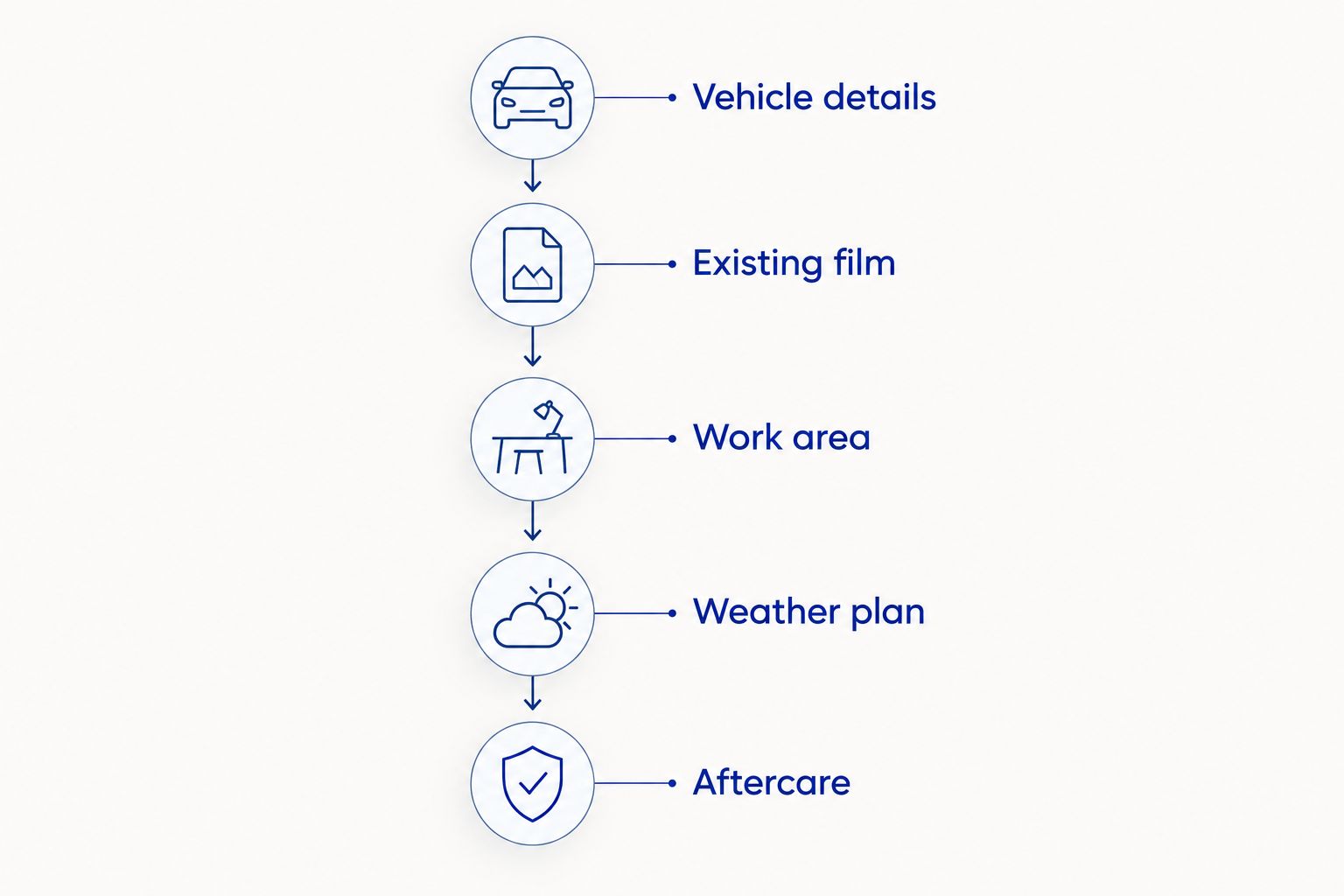
Mobile service removes the separate trip to an installation shop; it does not remove the need for controlled working conditions. Ask the installer to approve the location rather than assuming any driveway or parking space works.
Mobile tinting: the practical trade-off
Mobile tinting pros: You avoid transporting the vehicle to a separate shop, can discuss the vehicle at your location, and can plan around an on-site appointment.
Mobile tinting cons: The location needs approval, weather can affect the plan, and unsuitable parking can require a different arrangement. Best for: Drivers with a suitable location who value on-site service.
What to include in your quote request
A useful quote describes the job, not just the vehicle. Send the vehicle details, requested windows, existing-film condition, Sarasota installation location, and whether heat control or appearance matters most.
Ask for the exact film name, selected shade, removal work, preparation requirements, written warranty terms, and aftercare instructions. For Windowtintnear mobile window tinting, explain where the vehicle will be parked so the on-site setup can be discussed before scheduling.
Request your Sarasota tint quote
Share your vehicle, preferred windows, and parking setup to discuss a mobile installation.
How the options rank
Ceramic ranks first for a heat-focused buying decision; carbon earns a separate place as a metal-free alternative. Metallized and dyed films serve narrower priorities: reflective appearance and visible shading, respectively.
The ranking uses construction, documented performance, visibility, compatibility, and installation requirements. It does not assign unsupported scores to local businesses or treat every film within a category as identical.
Which window tint should you choose?
Start with ceramic, then make the installer explain the exact film and finished shade. Choose carbon when its specifications meet your needs; consider metallized or dyed film only when their distinct strengths match your priorities.
For Sarasota window tinting in 2026, a clear scope and suitable installation setup matter more than an unexplained premium label. Windowtintnear offers the mobile option; your next step is a vehicle-specific quote, not a guess from a generic shade chart.
FAQ
What's the best window tinting option for Sarasota heat?
Ceramic film is the first category to compare when heat control is your main priority. Ask for the exact film's solar-performance specifications and choose a shade that preserves practical visibility.
Is ceramic tint always better than carbon tint?
No; the category name alone does not settle the comparison. Compare the exact ceramic and carbon films at similar visible light transmission using the same performance measurements.
Can a mobile installer tint my car at home in Sarasota?
Mobile installation at home depends on whether the work area meets the installer's requirements. Windowtintnear offers mobile window tinting in Sarasota; describe your parking setup before booking.
What's the legal front-window tint in Florida?
Florida's front-side window rule requires at least 28% visible light transmission under section 316.2953. The finished glass-and-film combination matters, and separate reflectivity requirements apply.
Does darker window tint block more heat?
Darkness alone does not establish heat rejection. Compare solar-performance specifications separately from visible light transmission rather than choosing from appearance alone.
What affects a Sarasota window tinting quote?
The vehicle, windows included, selected film, existing-film removal, and installation requirements define the job being quoted. Provide those details and request an individual quote with a written scope.
When can I roll down my windows after tinting?
Follow the installer's written instructions for the film installed on your vehicle. Drying conditions and film requirements differ, so do not substitute a generic online waiting period for the specified aftercare.
One last thing
Choose your shade with nighttime driving in mind, not just the look of the parked vehicle. Tell the installer if you regularly reverse into an unlit driveway or drive poorly lit roads; that is useful information before film goes on the glass.
Ready to arrange mobile tinting in Sarasota? Request a quote from Windowtintnear with your vehicle details and parking setup, and explain which problem you want the tint to solve.